
How Venture Building Scales Startups With AI Automation
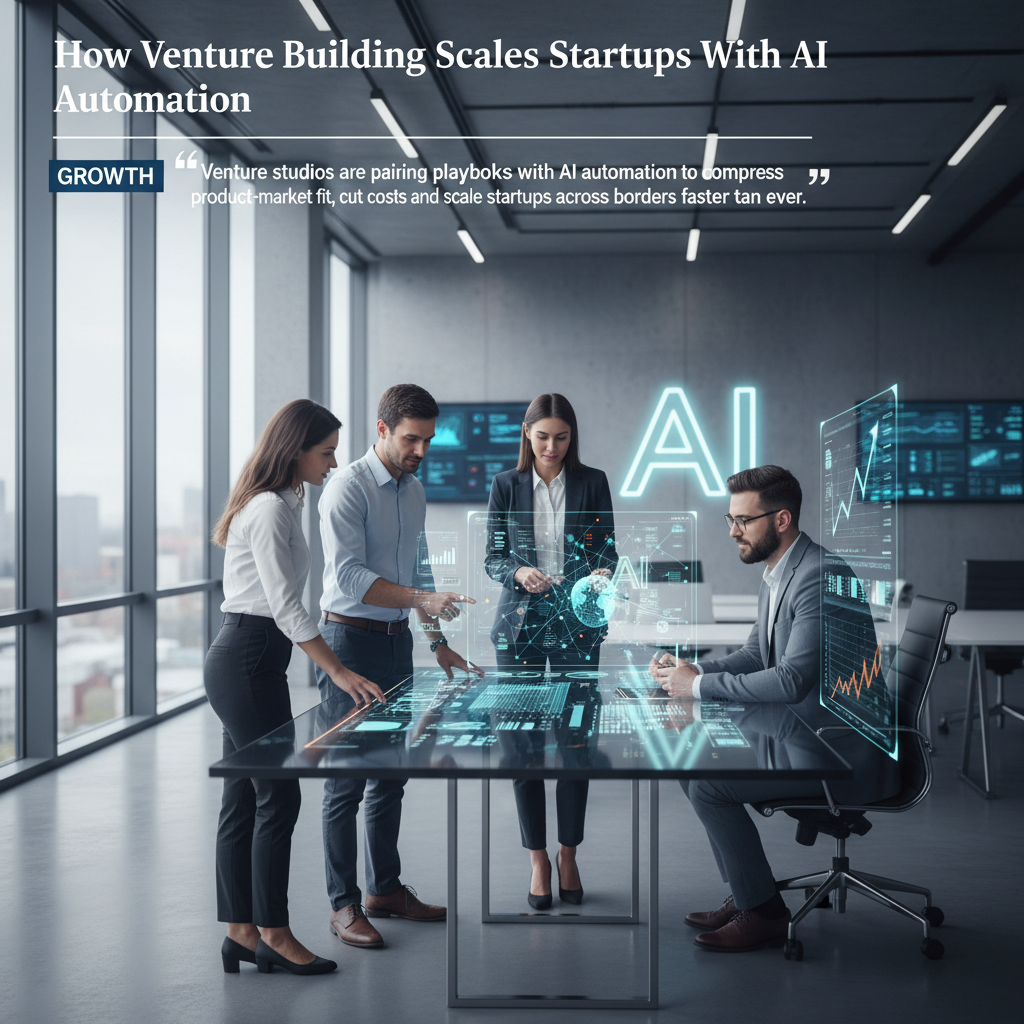
What You'll Learn
- 1Venture studios turn repeatable playbooks into scalable company factories.
- 2AI automation shortens time to market by automating core operational tasks.
- 3Designing modular systems preserves founder creativity while increasing throughput.
- 4Global scaling needs standardized processes plus localized market intelligence.
- 5Studios that integrate AI into operations unlock both efficiency and discovery.
What You'll Learn
-
How venture studios use standardized playbooks to launch and scale startups.
-
Where AI automation delivers the largest time and cost savings in venture building.
-
Practical design patterns for repeatable product, go-to-market and ops systems.
-
How to combine global scale with local market intelligence responsibly.
A team at a venture studio in Lisbon shipped a 0-to-1 payments product in 10 weeks, not 10 months. They did it by wiring a factory of shared services — AI-driven customer support, templated compliance checks, and automated data pipelines — around a small founding team. The result was not only speed, but a predictable repeatable process other teams could adopt and improve. The stakes are high: speed without repeatability wastes capital, and repeatability without discovery kills product-market fit. This is the tension modern studios must solve with both strategy and systems.
Why Venture Building Works
Venture studios are designed to concentrate learnings, capital and talent in one place so that startups are born from proven patterns, not guesswork. Instead of funding founders and hoping for serendipity, studios ideate, staff and operate multiple companies in parallel, applying playbooks learned across prior projects. That model reduces early-stage variance. What used to be one team's trial-and-error becomes a catalog of tested approaches a new team can inherit.
The consequence for investors is clearer risk-return tradeoffs: you fund a repeatable engine rather than isolated bets. Examples are visible across the ecosystem: firms like Idealab and Betaworks proved the studio model decades ago, while modern studios add platform services that accelerate later-stage metrics. For corporate partners, the studio becomes an R&D multiplier, not just a fund.
AI As The Operational Engine
AI automation converts the studio’s shared-services catalog from manual toil into an always-improving engine. Routine tasks such as customer onboarding, basic compliance checks, and first-line support are now automated with natural language models and automation tools, shaving weeks off launch timelines. Engineering teams use code assistants like GitHub Copilot to scaffold features, while APIs from major provider platforms reduce integration time for payments, identity and analytics.
This is not hypothetical. Studios that adopt AI for repetitive workflows redirect human time to product discovery and growth experiments. Automation also improves consistency: the same onboarding flow, instrumented and iterated across companies, reveals what moves retention and what does not. That data then feeds the playbook, closing the loop between automation and learning.
Designing Repeatable Growth Systems
The hard part is not automating tasks, it is building patterns that can be reused without flattening innovation. The best studios separate core, reusable systems from experiment layers. Think of a modular stack: shared infra and compliance modules at the bottom, standardized go-to-market templates in the middle, and product experiments where founders have autonomy at the top. This architecture preserves founder autonomy while capturing efficiencies.
Operationally, that means codifying processes as code, templates, and runbooks. A marketing playbook becomes a set of segmented acquisition flows, tracking schemas and A/B test templates that a new team can adopt and adapt. The payoff is faster iteration cycles and lower marginal cost per experiment, letting teams test more hypotheses with the same capital.
Scaling Globally Without Breaking
Scaling startups across regions exposes weaknesses in playbooks: localization, regulation and distribution all vary. Successful studios treat reproducibility and localization as twin design goals, building international growth as a configurable layer. They standardize what must be standard — data models, compliance scaffolds, instrumentation — and localize what must be local: language, payment rails, partnerships and cultural product-market fit.
Practically, studios deploy a mix of centralized AI models for utilities and localized human teams for market intelligence. For example, central NLP models handle routing and initial support, while local teams tune intent models and own escalation. This hybrid approach reduces operating costs while preserving the subtle market know-how that wins customers.
Metrics That Matter
Studios need a different dashboard than single startups. Time-to-first-revenue, cost-per-launch, and playbook reusability are leading indicators, alongside classic unit economics. Track how many experiments are reproducible, the percentage of automation-managed processes, and the delta in time-to-market after automation rollout. These metrics show whether a studio is truly getting leverage from its platform.
Equally important is measuring learning velocity: new insights per month that improve conversion, retention or pricing. When AI automation is instrumented correctly, you can convert operational telemetry into strategic insight. The math then favors the studio: each improvement compounds across every company that uses the shared system.
The Bottom Line
The future of startup formation is not solo founders hacking in isolation; it is distributed teams leveraging centralized playbooks. Venture studios that pair disciplined repeatable processes with AI automation will compress time-to-market, reduce variance, and multiply learning across a portfolio. This model preserves the creative spark by moving routine work to automation and shared systems, freeing founders to focus on product discovery and go-to-market craft.
For leaders and investors, the active play is clear: invest in platforms and operating models that turn discovery into a systematic process, instrument the work so AI can amplify it, and design for global scale from day one. Do that, and you build not just companies, but a durable engine for startup creation.