
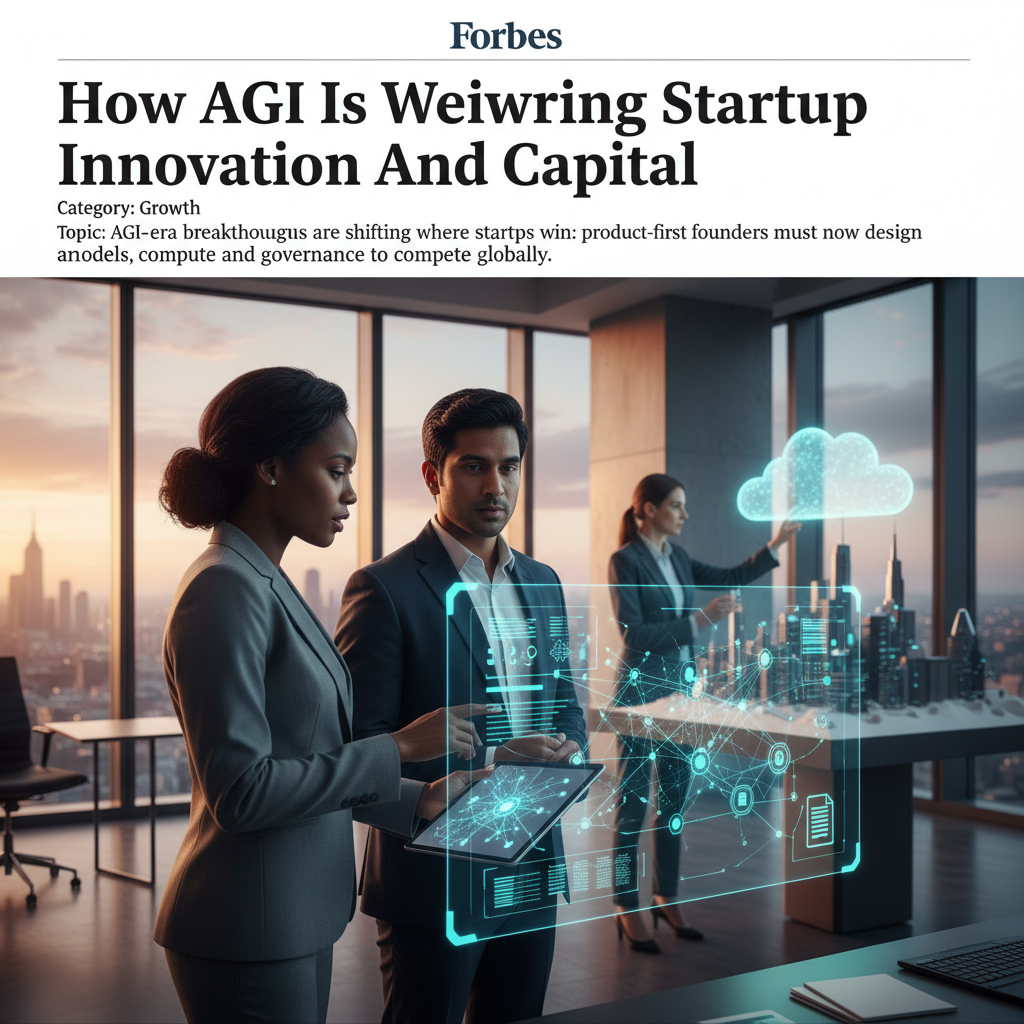
How AGI Is Rewiring Startup Innovation And Capital
What You'll Learn
- 1Product roadmaps are becoming model-first, not feature-first.
- 2Capital is concentrating on core model builders and compute access.
- 3Venture studios can lower barriers to AGI experimentation.
- 4Governance and safety are now investment filters.
- 5Geography matters less than access to talent and infrastructure.
What You'll Learn
-
How AGI changes product priorities and go-to-market timing.
-
Why capital and talent are gravitating to model builders and infrastructure.
-
How venture studio models reduce risk and speed iteration for AI startups.
-
What governance and compute mean for investors and founders.
There is a dramatic mismatch between the startup playbook investors have rewarded for a decade and the one AGI now demands. Teams that once shipped feature releases and measured growth with A/B tests are being forced to think in terms of model scale, data curation and regulatory contours. That shift is not theoretical: it changes who gets capital, which companies survive, and how quickly new markets form.
AGI Is Shifting The Product Playbook
Today’s winning products often begin with a model decision, not a feature list. A startup that chooses an LLM or multimodal model at the outset rearranges engineering priorities, metrics and hiring: you need data engineers, prompt architects and model ops specialists before you ship the first customer-facing screen. Companies that treat models as a replaceable component risk rework and missed product-market fit.
This model-first approach shortens the iteration loop for capabilities but lengthens capital and compute needs. Early capacity for fine-tuning, evaluation and safety testing becomes a competitive advantage, because it reduces time to reliable, trustable behavior in production. The practical result: product speed now depends on access to scalable compute and disciplined ML operations, not only on UI polish.
Capital Concentrates Around Model Builders
Investors are reallocating dollars toward entities that control core models, data, or compute pipelines. Strategic investments into model-centric startups and cloud partners show up across rounds; public evidence includes heavy purchases of GPUs by hyperscalers and large private rounds for companies focused on model architecture or distributed training. This concentration creates a two-tier market: companies building foundational models and those building applications that depend on them.
For founders, that means fundraising narratives must stress defensibility beyond user growth. VCs now evaluate datasets, compute partnerships, and reproducible safety practices alongside unit economics. McKinsey’s long-standing estimate that AI could add trillions to the global economy by 2030 is often cited to justify bets, but the more immediate effect is capital clustering where models, data and compute intersect.
Talent And Infrastructure Are The New Moats
The barrier to entry is less about a clever front-end and more about assembling teams that can maintain and govern large models. Talent flows toward companies offering hard ML problems, reliable compute budgets, and cross-disciplinary safety work. That is why notable AI teams, from international labs to startups, compete aggressively for applied researchers and data engineers.
Hardware and cloud relationships matter as much as human capital. NVIDIA GPUs and custom accelerators remain scarce and expensive, and startups that secure early capacity avoid brittle pauses in training schedules. Open model efforts like Stability AI show the opposite effect: open access can democratize experimentation but still requires orchestration and scale to translate into commercial advantage.
Why Venture Studios Matter Now
The venture studio model is uniquely suited to the AGI era because it pools capital, talent, compute and governance under a single roof. Studios can internalize expensive shared infrastructure — from GPU clusters to continuous evaluation pipelines — and amortize those costs across multiple ventures. That reduces the burn rate for each project and accelerates the experimentation necessary to find durable product-model combinations.
Beyond cost, studios enforce operational discipline that young AI teams need: standardized data practices, reproducible training, and built-in safety reviews. For VENSOS and similar platforms, the studio becomes a laboratory where model-led ideas can be stress-tested faster and more cheaply than in stand-alone startups. The strategic advantage is speed combined with risk management.
Governance, Safety And Market Signals
Regulatory frameworks are no longer peripheral risks. The EU AI Act, enacted in 2023, and emerging rules in other jurisdictions make safety practices a commercial requirement. Investors are increasingly asking for documented governance, red teams, and continuous monitoring before allocating follow-on capital. Startups that lack these controls face slower sales cycles with enterprise customers and higher diligence friction from institutional backers.
Market signals also reward transparency. Companies that publish evaluation benchmarks, safety audits, and clear data provenance gain trust with partners and customers. That trust converts into differentiated enterprise deployments, which remain the most reliable path to revenue for many AI-first startups.
Geography Is Becoming A Network, Not A Map
Talent and compute network effects blur geopolitical boundaries. You no longer need to be in Silicon Valley to access leading researchers or GPUs, but you do need the right connections and partnerships. Remote-first teams can assemble excellence, yet physical hubs still matter where capital, mentors and customers meet.
Emerging ecosystems in Europe, India, and Southeast Asia are producing both model research and deep application expertise. Global VCs will follow technical capability and commercial traction rather than headquarters location. The practical implication for founders is to optimize networks, not just addresses.
The Bottom Line
AGI developments rewire the startup landscape by making models, compute and governance the core strategic assets. The old checklist of growth, retention and virality remains important, but it is now filtered through whether a team can scale models responsibly and maintain privileged access to data and infrastructure.
For investors and founders, the lesson is operational: align incentives around reusable infrastructure, embed safety and governance early, and choose fundraising narratives that emphasize model defensibility. For venture studios like VENSOS, the opportunity is to be the infrastructure layer that lets promising teams move from prototype to product without burning through capital or compromising safety.
Start building your playbook now: invest in shared compute, codify safety practices, and structure ventures to reuse core model assets, because the companies that win the AGI era will be those that treat models as the platform, not an add-on.