
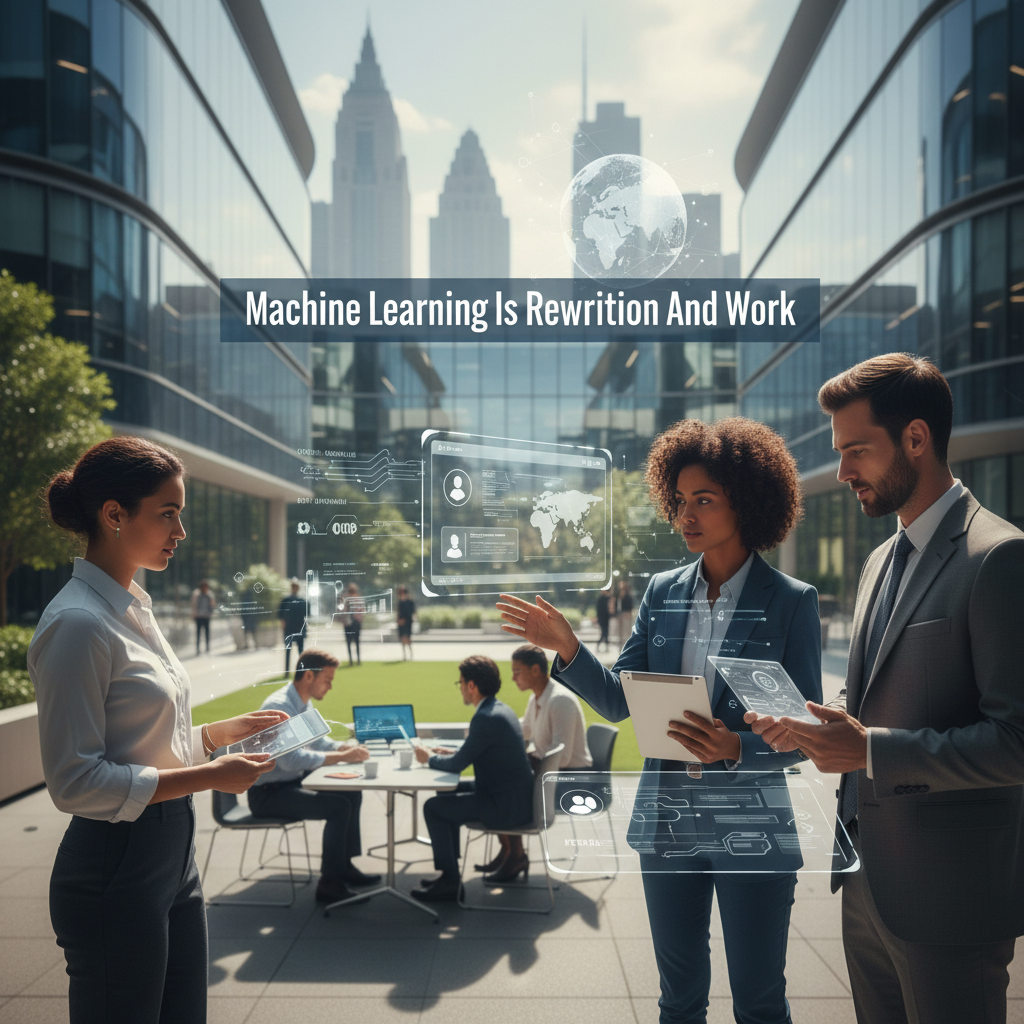
Machine Learning Is Rewriting Education And Work
What You'll Learn
- 1ML shifts education from content delivery to competency orchestration.
- 2Employers and edtech startups now co-own skilling pathways.
- 3Venture capital is following models that blend product and placement.
- 4Design for measurable job outcomes, not just engagement.
What You'll Learn
-
ML turns one-size-fits-all education into adaptive, competency-based learning.
-
Global employers increasingly partner with edtech to guarantee job-ready skills.
-
Venture studios and investors favor products tied to measurable hiring outcomes.
-
Leaders need operational plans for integrating ML into learning and recruitment.
There are classrooms where a learner’s next five math problems are chosen by an algorithm, and hiring teams across three continents screen candidates by projects scored with the same models. That convergence is no accident. Machine learning has migrated from back-end analytics into the user experience of learning and into the hiring pipeline, creating a single feedback loop that changes what education sells and what work buys. Read closely: this is how new ventures will win customers, partners, and capital in the coming decade.
The Machine Learning Inflection
Machine learning is more than automation. It is a new pedagogy: continuous assessment, real-time feedback, and personalization at scale. Companies such as Duolingo and Khan Academy have already shown how models can tailor practice and content sequencing to individual learners, increasing time-on-task and mastery rates.
On the employer side, ML powers skills taxonomies and candidate matching, turning learning signals into hiring signals. Platforms that bridge those signals — mapping mastery on a platform to a role requirement — convert education from a speculative investment into a predictable pipeline for talent. This changes revenue models: schools and startups can no longer survive on usage alone; they must demonstrate outcomes employers value.
How Education Models Are Rewiring
Credentialing, not courses, is what buyers want. Microcredentials, assessed project portfolios, and employer-verified badges are replacing credit hours. Coursera and industry-aligned bootcamps have proven that employers will accept shorter, skills-first credentials when they trust the assessment.
At the same time, lifelong learning is becoming an operational expense for companies, not a perk. Organizations from large multinationals to regional SMEs increasingly partner with edtech providers to reskill workers. That shift turns education providers into strategic workforce partners, accountable for both learning and placement outcomes.
What Venture Investors Are Betting On
Investors are placing bets where education meets measurable labor-market impact. Four clear product archetypes have emerged as favorites among venture funds and studios.
1. Adaptive Learning Platforms
These platforms use ML to personalize the learning path and predict who will succeed in a course. The advantage is clearer retention and demonstrable improvement in mastery rates, which investors can translate into lifetime value models.
The bottom line: Personalization increases learner ROI and makes unit economics predictable.
2. Employer-Integrated Upskilling
Startups that embed their curriculum inside corporate HR systems, provide reporting dashboards, and align content to internal job frameworks are attracting strategic deals. Guild Education and others show that partnership revenue scales faster and converts into multi-year contracts.
The bottom line: Direct employer alignment turns education revenue into recurring workforce spend.
3. Assessment-as-a-Service
Neutral, ML-driven assessment platforms that evaluate portfolios, projects, and soft skills are emerging as critical infrastructure. They reduce hiring friction by giving firms objective, comparable metrics across candidate pools.
The bottom line: Independent assessments bridge learning and hiring, unlocking marketplace value.
4. Content-To-Placement Marketplaces
Hybrid marketplaces that combine short, ML-personalized courses with guaranteed interviews or apprenticeship placements de-risk hiring for employers and students. When studios can orchestrate both sides, they capture referral fees, tuition, and placement premiums.
The bottom line: Integrated marketplaces convert educational outcomes directly into monetizable talent pipelines.
Designing For The Workforce Transition
Product teams and founders must stop optimizing for engagement metrics alone. Investors and corporate partners demand signals that predict on-the-job performance: project scores, live assessments, and employer feedback loops. Machine learning helps only if it is trained on outcomes that matter to hiring managers.
Operationally, this means partnerships, not periphery integrations. Pilot placements, shared success metrics, and data-sharing agreements are the hard work most founders skip. Venture studios like VENSOS can accelerate this by offering go-to-market relationships and engineering talent to embed ML models into both the learning product and employer workflows.
Scaling Outside Silicon Valley
The global talent crisis is not uniform. Regions like Latin America, Africa, and Southeast Asia offer growth not because labor is cheaper, but because local cohorts can be trained for global digital work through localized, ML-enabled pathways. Startups that pair culturally tuned content with robust assessment and placement mechanisms win faster adoption.
Capital flows are following adoption: investors in Europe and Asia increasingly prefer local operators who combine strong technical teams with employer networks. For founders, that means building dual narratives: one for investors about unit economics, and one for employers about reliable hiring outcomes.
The Bottom Line
Machine learning is changing the contract between education and work: learning is now judged by employability, and employers are paying to shape the curricula that produce hires. That shift creates a playbook for founders and investors: build adaptive assessment systems, secure employer partnerships that validate outcomes, and monetize placement as well as learning.
For leaders, the action is operational. Invest in ML models trained on job-relevant outcomes, structure partnerships that share risk and reward with employers, and design credentials that translate to measurable on-the-job performance. Do that and you will turn education from a speculative promise into a repeatable engine of talent and revenue.